
How Do Gift Cards Work for Food Halls?
A food hall gift card is one of the best gifts a hall can sell: one card, a dozen kitchens, and a reason to come back. How well it works for the operator depends on two choices: whether the program runs hall-wide or vendor by vendor, and whether the money behind every card is tracked in one ledger.
Quick answer: The strongest food hall gift card programs are centralized: guests buy one hall-wide card, sales from any tenant flow into the operator's central account, and each redemption routes funds to the vendor who served the order. Federal law sets a five-year minimum before a gift card can expire, and many states, including California, Connecticut, Florida and Washington, generally ban expiration dates altogether. Tabski, the restaurant and food hall POS, offers a native gift card program that works across every vendor in the hall that runs on Tabski POS. See also Ledger & Routing, Food Hall POS and the U.S. Food Hall Directory. Ready to launch one? See Tabski Gift Cards for programs and pricing.
Centralized vs Decentralized Gift Card Programs
Every food hall gift card program falls into one of two models.
Decentralized (per-vendor) programs
Each vendor sells its own cards on its own system, and those cards only work at that stall. This is simple to start because no one has to coordinate, but guests notice the limits quickly. A card from the burger stall cannot buy a cocktail at the bar, the hall cannot sell one gift that covers the whole building, and the operator has no view of how much gift card value is outstanding across the property.
Centralized (hall-wide) programs
The hall sells one gift card that works at every participating vendor. Guests treat the hall as a single destination, which is exactly how operators market it. Benefits for the operator include:
- One product to promote. Holiday campaigns, corporate gifting and event giveaways all point to a single hall-branded card. For the operator playbook, see Food Hall Corporate Gift Cards (Holiday Playbook).
- Central visibility. Every tenant's gift card sales land in the operator's central account, and reporting shows outstanding gift card liability in one place.
- Visits that spread across vendors. A guest with a hall-wide balance can try a new stall without risking money, which helps newer tenants build a following.
- Clean vendor settlement. When every redemption is recorded against the vendor that served it, payouts are calculated from transactions, not spreadsheets.
- Consistent guest terms. One set of terms and disclosures for the whole hall, reviewed once, instead of a different policy at every counter.
| Question | Decentralized (per vendor) | Centralized (hall-wide) |
|---|---|---|
| Where can the guest spend it? | One stall | Every participating vendor |
| Who sells it? | Each vendor | The hall, online and at any counter |
| Where the money goes | Each vendor keeps its own card sales | Operator's central account, then routed to the vendor that served the order |
| Vendor settlement | Not needed, but no cross-vendor spend | Each redemption routed to the vendor that served it |
Expiration and Fee Rules: Federal and State
Not legal advice. This section summarizes public statutes, regulations and official state guidance as of October 2026 for general information only. Laws change, exceptions apply, and the rules that govern your program depend on where cards are sold and redeemed. Review your gift card terms with your own attorney before launch.
The federal floor: five years
The Credit CARD Act of 2009 amended the Electronic Fund Transfer Act to add 15 U.S.C. 1693l-1. It makes it unlawful to sell or issue a gift certificate or store gift card with an expiration date unless the expiration date is at least five years after the card was issued or funds were last loaded, and the expiration terms are clearly and conspicuously stated. The same section limits dormancy, inactivity and service fees, and the Consumer Financial Protection Bureau implements these rules in Regulation E, 12 CFR 1005.20. Federal law does not override state laws that give consumers more protection, so follow whichever rule is stricter where you sell cards.
State by state: expiration and fee rules
Each state rule below was checked against the official state statute or an official state government source, linked in the right column. Where we did not find and verify a state specific gift card rule, the row says federal rules apply and points to the federal statute. Those states may still have related laws, such as unclaimed property rules, so check with counsel.
| State | Expiration and fee rule (summary) | Official source |
|---|---|---|
| Alabama | Federal rules apply; check state law. | 15 U.S.C. 1693l-1 |
| Alaska | Federal rules apply; check state law. | 15 U.S.C. 1693l-1 |
| Arizona | Fees prohibited; underlying funds may not expire (card itself may carry a date only with a clear disclosure that funds do not expire). | A.R.S. 44-7402 |
| Arkansas | Federal rules apply; check state law. | 15 U.S.C. 1693l-1 |
| California | Expiration dates and service fees generally prohibited; narrow dormancy fee exception. | Cal. Civ. Code 1749.5 |
| Colorado | Gift cards may not carry service, dormancy, inactivity, maintenance or other fees. | C.R.S. 6-1-722 |
| Connecticut | Expiration dates prohibited; dormancy and inactivity fees prohibited. | Conn. Gen. Stat. 42-460 and 3-65c |
| Delaware | Federal rules apply; check state law. | 15 U.S.C. 1693l-1 |
| District of Columbia | Federal rules apply; check state law. | 15 U.S.C. 1693l-1 |
| Florida | No expiration date and no post-sale fees, with limited exceptions (charity, employee incentive, promotional). | Fla. Stat. 501.95 |
| Georgia | Federal rules apply; check state law. | 15 U.S.C. 1693l-1 |
| Hawaii | Gift cards honored at least 5 years (paper-only certificates 2 years); service and dormancy fees prohibited. | HRS 481B-13 (Hawaii DCCA) |
| Idaho | Federal rules apply; check state law. | 15 U.S.C. 1693l-1 |
| Illinois | No expiration earlier than 5 years after issuance; no post-purchase fees. | 815 ILCS 505/2SS |
| Indiana | Federal rules apply; check state law. | 15 U.S.C. 1693l-1 |
| Iowa | Federal rules apply; check state law. | 15 U.S.C. 1693l-1 |
| Kansas | No expiration less than 5 years from purchase; no fees within 12 months of issuance. | K.S.A. 50-6,108 |
| Kentucky | No expiration less than 1 year after issuance; no value-reducing fees before the expiration date. | KRS 367.890 |
| Louisiana | No expiration less than 5 years from issuance; no service or dormancy fees (one-time handling fee up to one dollar allowed). | La. R.S. 51:1423 |
| Maine | Federal rules apply; check state law. | 15 U.S.C. 1693l-1 |
| Maryland | No expiration or fee of any kind within 4 years after purchase. | Md. Code, Com. Law 14-1319 |
| Massachusetts | Valid at least 7 years after issuance; redeemable indefinitely if no expiration date is disclosed. | M.G.L. c. 200A, 5D |
| Michigan | No expiration within less than 5 years; no inactivity or other service fees. | MCL 445.903g and 445.903f |
| Minnesota | Expiration dates and service fees, including dormancy fees, prohibited. | Minn. Stat. 325G.53 |
| Mississippi | Federal rules apply; check state law. | 15 U.S.C. 1693l-1 |
| Missouri | Federal rules apply; check state law. | 15 U.S.C. 1693l-1 |
| Montana | Gift certificates do not expire; no fees, including dormancy fees, may reduce value. | MCA 30-14-108 |
| Nebraska | Federal rules apply; check state law. | 15 U.S.C. 1693l-1 |
| Nevada | Expiration and service fees allowed only with required printed disclosures; inactivity fees only after 3 years of nonuse. | NRS 598.0921 |
| New Hampshire | No expiration on certificates of 250 dollars or less; dormancy and administrative fees prohibited. | RSA 358-A:2, XIII |
| New Jersey | Federal rules apply; check state law. | 15 U.S.C. 1693l-1 |
| New Mexico | Federal rules apply; check state law. | 15 U.S.C. 1693l-1 |
| New York | No expiration earlier than 9 years after issuance or last load; fees generally prohibited. | N.Y. Gen. Bus. Law 396-i (as amended by S3467B) |
| North Carolina | No maintenance fees for one year after purchase; any fees must be disclosed on the card. | N.C.G.S. 66-67.5 |
| North Dakota | Federal rules apply; check state law. | 15 U.S.C. 1693l-1 |
| Ohio | No expiration less than 2 years after issuance; no value-reducing fees within 2 years. | Ohio Rev. Code 1349.61 |
| Oklahoma | Federal rules apply; check state law. | 15 U.S.C. 1693l-1 |
| Oregon | Expiration dates, declining value and fees generally prohibited; cash back under 5 dollars after first use. | ORS 646A.276 |
| Pennsylvania | Federal rules apply; check state law. | 15 U.S.C. 1693l-1 |
| Rhode Island | Expiration dates and service or maintenance fees prohibited. | R.I. Gen. Laws 6-13-12 |
| South Carolina | No expiration before 1 year (unless prominently printed); fees and declining value must be clearly disclosed. | S.C. Code 39-1-55 |
| South Dakota | Federal rules apply; check state law. | 15 U.S.C. 1693l-1 |
| Tennessee | Federal rules apply; check state law. | 15 U.S.C. 1693l-1 |
| Texas | Expiration and fees allowed only if clearly disclosed; value-reducing fees not before the first anniversary. | Tex. Bus. & Com. Code ch. 604 |
| Utah | Federal rules apply; check state law. | 15 U.S.C. 1693l-1 |
| Vermont | Paid value valid at least 5 years after issuance or last load; dormancy and service fees prohibited. | 8 V.S.A. 2702 and 2703 |
| Virginia | Expiration must be disclosed; dormancy, inactivity and service fees prohibited on paid certificates. | Va. Code 59.1-531 |
| Washington | Expiration dates, fees and dormancy charges prohibited, with limited exceptions. | RCW 19.240.020 |
| West Virginia | Federal rules apply; check state law. | 15 U.S.C. 1693l-1 |
| Wisconsin | Federal rules apply; check state law. | 15 U.S.C. 1693l-1 |
| Wyoming | Federal rules apply; check state law. | 15 U.S.C. 1693l-1 |
Practical takeaways for operators
- Plan for cards that do not expire. It is the simplest way to comply in strict states and it is what guests expect.
- Avoid dormancy and service fees unless your attorney has confirmed they are allowed where you operate.
- Promotional cards given away for free can follow different rules than cards guests pay for. Label them clearly.
- Ask counsel how your state treats unused balances under unclaimed property law.
Tabski Gift Cards: Digital and Physical, Every Vendor
Tabski's native gift card program is built into the same restaurant and food hall POS that runs every vendor in the hall. The program includes:
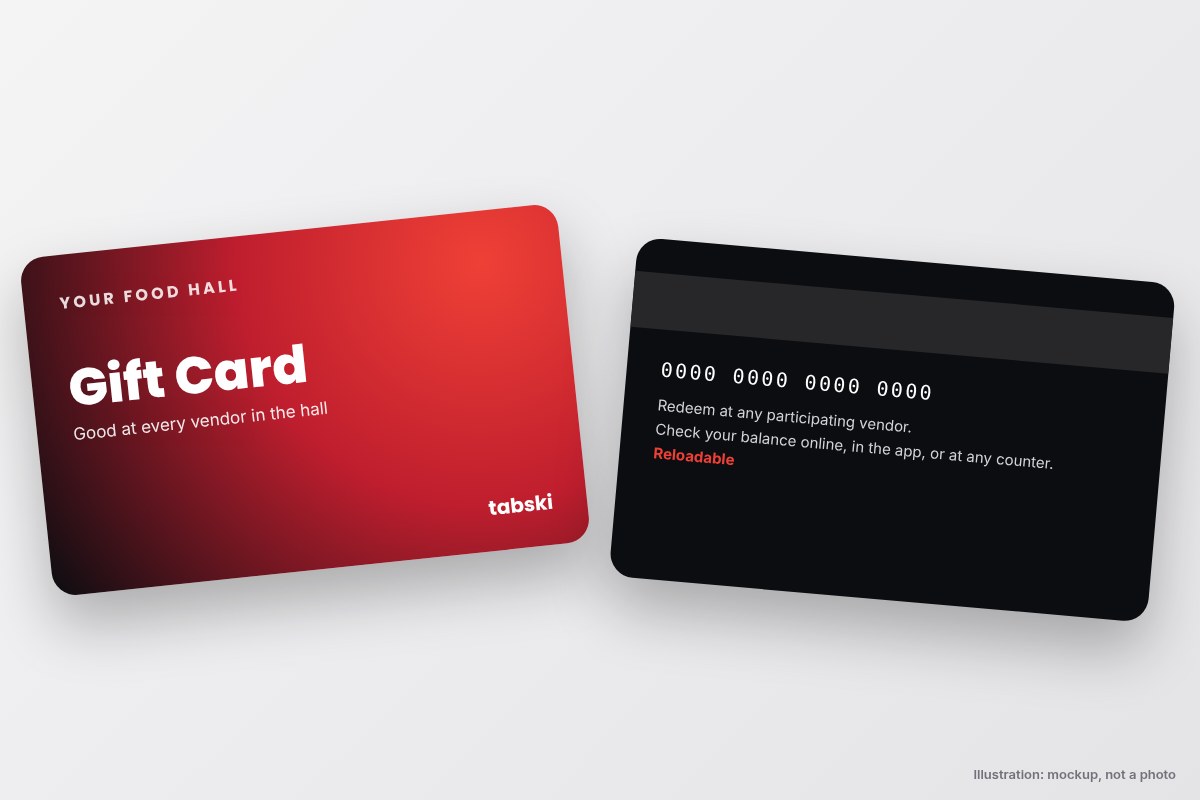
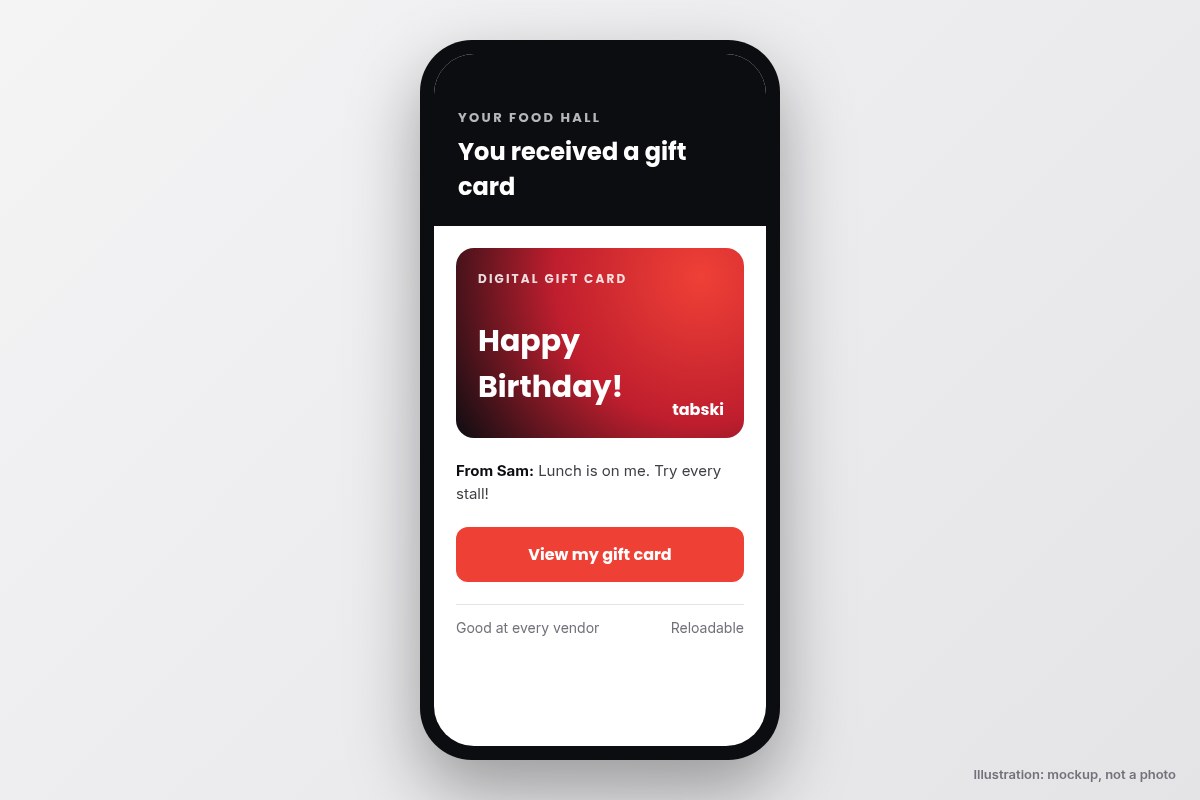
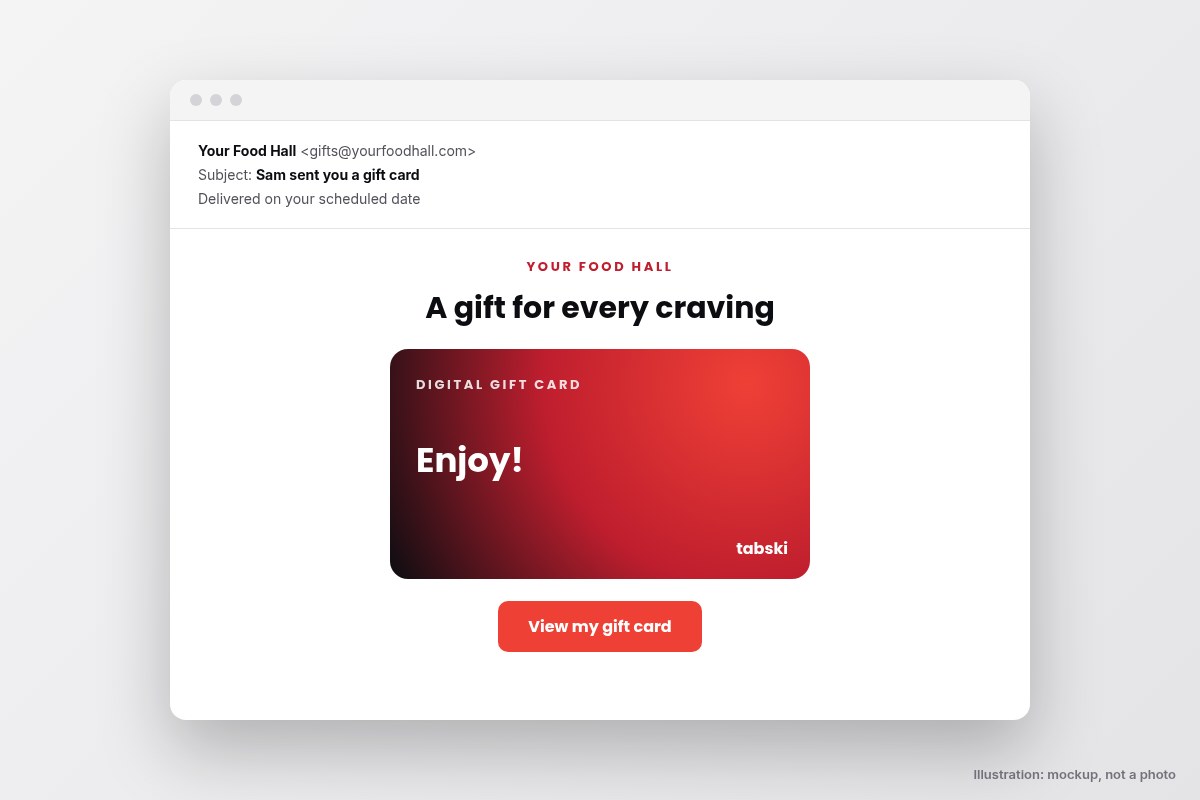
- Digital gift cards sold on the hall's own website and delivered to recipients by email and text, with scheduled delivery so a guest can buy today and have the card arrive on a birthday or holiday.
- Physical gift cards that guests can pick up and hand over in person.
- Reloadable cards, so guests can add value and keep coming back.
- Easy balance checks on the hall's website, in the mobile app or at the POS.
- Hall-wide redemption at every participating vendor in the hall.
How the Tabski Ledger Handles Gift Card Money
Gift cards are a financial product, so they belong in the Tabski ledger, the same record that powers reporting, routing and settlement for every order in the hall.
- Sale. Every tenant's gift card sales land in the operator's central account, whether the card was sold online or at any vendor's counter.
- Redemption. When a guest spends the card, the ledger records which vendor served the order.
- Routing. The redeemed amount is routed to that vendor by ACH.
- Reporting. Operator reporting shows outstanding gift card liability, so the hall always knows how much card value is still out with guests.
Because one ledger records both the sale and the redemption, every dollar stays attached to the transaction it came from.
Why a Native Program Matters
Many halls bolt on a third-party gift card tool. Guests feel the seams: a card that works at the counter but not online, or a balance that only one system can see. A native program runs on the same platform as everything else, so a guest gets one experience across mobile ordering, online ordering and walk-up orders at the POS.
- One reloadable balance, wherever the guest orders, with balance checks on the website, in the app or at the POS.
- One platform for the operator: the food hall POS they already use.
- One ledger, so redemptions route to the right vendor without manual reconciliation.
Sell one card for the whole hall, and let the ledger do the math.
A centralized gift card turns the hall into the gift. Pair it with terms that respect federal and state rules, and with a ledger that routes every redemption to the vendor who earned it, and gift cards become a steady source of new visits for every tenant.
Frequently Asked Questions
How do gift cards work in a food hall?
In a centralized program, the food hall sells one gift card that guests can spend at any participating vendor. Every tenant's gift card sales land in the operator's central account, and each redemption is routed to the vendor whose food was purchased. In a decentralized program, each vendor sells cards that only work at its own stall.
Can a food hall gift card be used at every vendor?
Yes, when the hall runs a centralized program. A hall-wide card works across every vendor in the hall that runs on Tabski POS, so a guest can split one card balance between a taco stall, a pizza counter and the bar.
Can food hall gift cards expire?
Under federal law (15 U.S.C. 1693l-1 and Regulation E, 12 CFR 1005.20), a gift card generally cannot expire sooner than five years after it was issued or last loaded, and the expiration terms must be clearly disclosed. Many states go further, and some, including California, Connecticut, Florida, Minnesota, Montana, Rhode Island and Washington, generally prohibit expiration dates on paid gift cards, subject to limited exceptions. See the state table in this guide. This is general information, not legal advice.
Can a food hall charge fees on gift cards?
Federal rules sharply limit dormancy, inactivity and service fees, and many states, including California, Colorado, Connecticut, Michigan, Minnesota, Montana, Vermont and Washington, generally prohibit service or dormancy fees, with narrow exceptions. Check the rules in your state with your attorney before setting any terms.
What does the Tabski gift card program include?
Tabski's native gift card program includes digital gift cards sold on the hall's website and delivered by email and text, including scheduled delivery, plus physical gift cards. Cards are reloadable and work across every vendor in the hall that runs on Tabski POS, and guests can check balances on the website, in the mobile app or at the POS.
Who gets the money when a food hall gift card is redeemed?
With Tabski, every tenant's gift card sales land in the operator's central account. When a card is redeemed, the funds are routed by ACH to the vendor that served the order, and operator reporting shows outstanding gift card liability.
How is a gift card split between vendors when one order includes several stalls?
With Tabski, one order can include items from several vendors and be paid with one gift card. The redemption is split by vendor, so each vendor is credited for the items it served and paid by ACH, and the operator sees the split in reporting.
Hall-Wide Gift Cards for Every Vendor.
See how Tabski, the restaurant and food hall POS, sells gift cards across every vendor and routes each redemption through one ledger.