
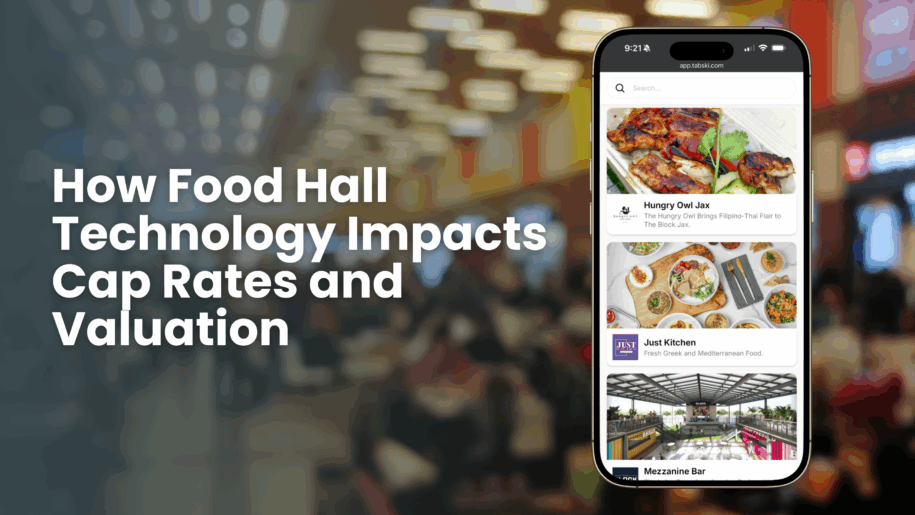
Food halls have evolved from trendy dining concepts into serious commercial real estate assets. As investors, lenders, and developers look beyond foot traffic and brand appeal, one factor is increasingly influencing cap rates, exit multiples, and financing terms: technology infrastructure.
In this article, we break down how food hall technology directly impacts valuation, why outdated systems quietly suppress asset value, and what modern operators are doing to unlock higher returns.
Why Cap Rates Matter for Food Halls
A capitalization rate reflects how risky or stable an income producing property appears to investors. Lower cap rates translate into higher valuations and are driven by predictable income, transparent financials, reduced operational risk, and scalable systems.
For food halls, technology now sits at the center of all four.
The Unique Valuation Challenge of Food Halls
Unlike single tenant restaurants or traditional retail, food halls introduce operational complexity. Multiple vendors operate under different economic models, often with percentage based rent structures, shared infrastructure, and higher turnover risk.
Without the right technology in place, these variables increase uncertainty. Investors price that uncertainty as risk, which raises cap rates and lowers valuation.
Revenue Transparency Lowers Risk
Many food halls still rely on self reported sales, delayed reconciliations, or manual spreadsheets. This leads to inconsistent rent collection, vendor disputes, and income streams that are difficult to verify.
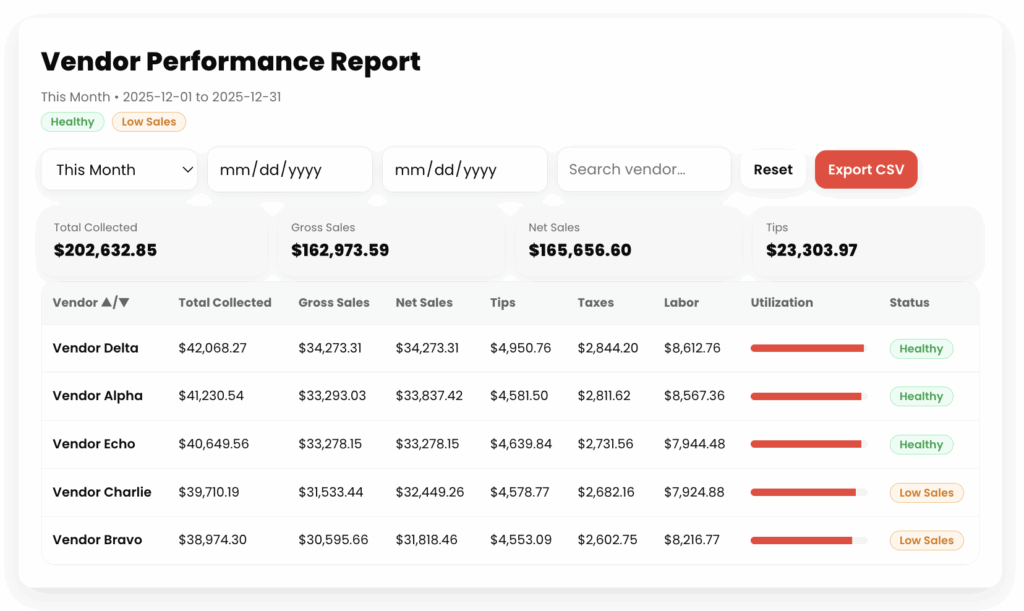
From an investor perspective, revenue that cannot be independently validated is inherently riskier. Technology that delivers real time gross sales tracking, automated rent calculations, and centralized reporting shifts revenue from estimated to auditable. That reduction in uncertainty directly improves valuation.
Automated Rent Collection Stabilizes NOI
Net operating income is the foundation of any valuation model. Manual rent processes introduce late payments, underreported sales, unnecessary administrative work, and cash flow volatility.
Automated rent collection enables consistent settlement schedules, automatic splits before funds reach vendors, and eliminates reliance on tenant compliance. The result is more predictable income, which supports lower cap rates and stronger valuations.
Vendor Turnover Becomes Manageable
Vendor churn is one of the biggest red flags for food hall investors. Without modern systems, onboarding a new vendor can take weeks, require new hardware, and disrupt ordering across the hall.
Centralized food hall technology allows new vendors to be onboarded quickly using shared infrastructure. Menus, payments, and reporting are standardized, which minimizes downtime and revenue loss. This turns vendor turnover from a threat into a manageable operational factor in underwriting models.
Direct Ordering Protects Margins
Third party marketplaces quietly erode net operating income through commission fees, refund leakage, and loss of customer ownership. Technology that supports direct digital ordering keeps transactions in house, preserves margins, and improves customer lifetime value.
Revenue that is not dependent on external platforms is more defensible, more predictable, and far more attractive to investors.

Institutional Grade Reporting Expands the Buyer Pool
Food halls that aim to attract institutional buyers or regional developers must meet higher standards of reporting and transparency. Advanced technology provides consolidated financials, vendor level performance insights, historical trend analysis, and forecasting capabilities.
This positions the food hall as a professionally managed asset rather than an operational burden. As a result, more buyers are willing to engage, which improves pricing and exit terms.
Technology Enables Portfolio Scale
Single location food halls trade differently than repeatable concepts. When technology is standardized across locations, financials become comparable, staffing models are repeatable, and expansion risk is reduced.
Multi location operators often command premium valuations because systems drive performance rather than individual managers.
Technology Is Now a Valuation Lever
Food hall technology is no longer just an operational tool. It directly influences cap rate compression, net operating income predictability, investor confidence, and exit valuation.
Developers who treat technology as core infrastructure rather than an afterthought position their assets for stronger financing terms, higher valuations, and smoother exits.
Key Takeaways
Revenue transparency reduces perceived risk
Automated rent collection stabilizes net operating income
Vendor turnover becomes manageable rather than dangerous
Direct ordering protects margins
Institutional grade reporting attracts better buyers
In today’s market, food halls with outdated technology are often worth less, even when foot traffic appears strong.