
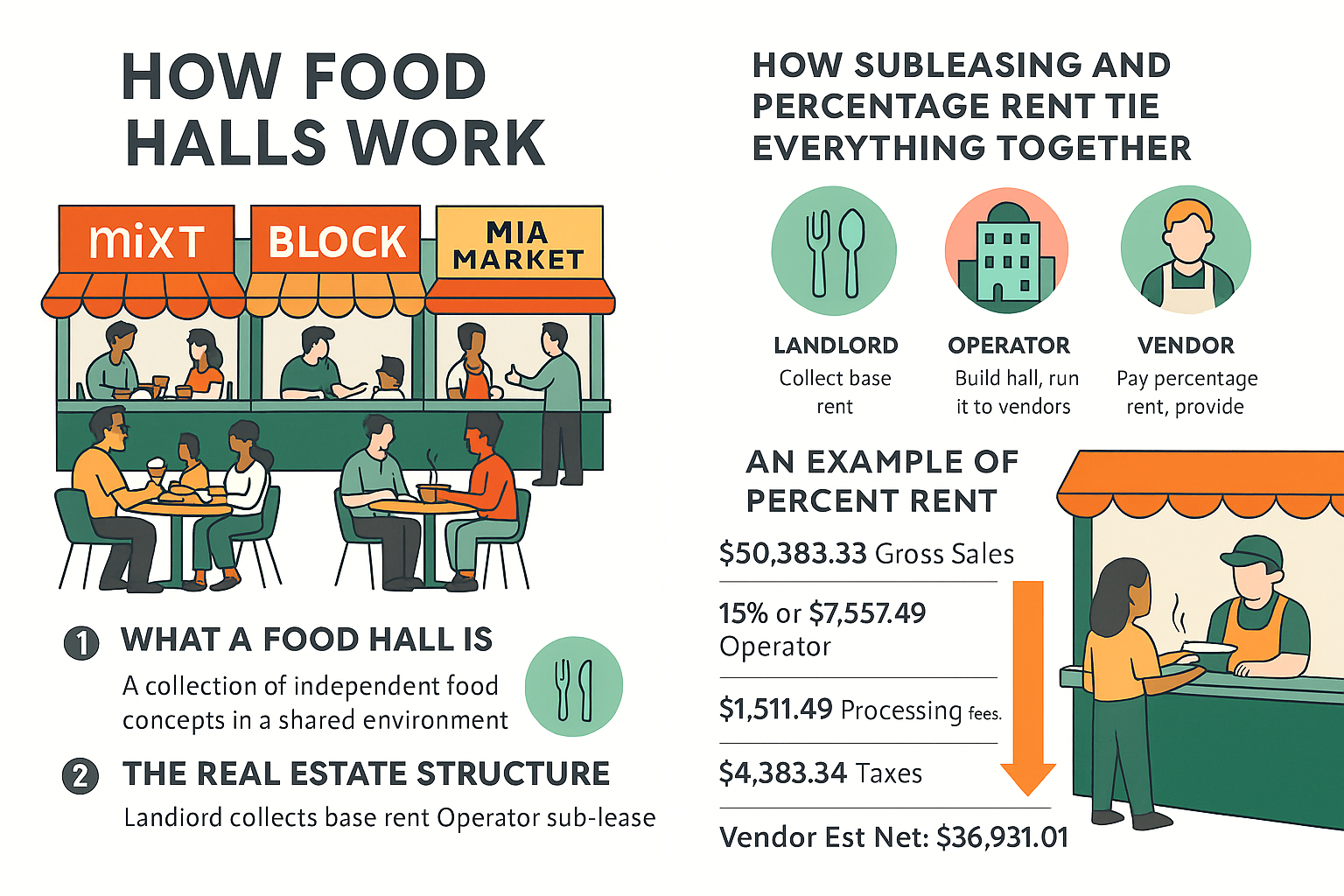
A complete guide to real estate, brokers, operators, vendor economics, and how the percentage rent model functions
(With insights and examples from leading operators and industry research)
Food halls have become one of the most effective tools for modern placemaking. They attract foot traffic, energize mixed use developments, support emerging chefs, and reshape how landlords think about food and beverage within a property. What guests experience as a lively communal space is, behind the scenes, a carefully engineered ecosystem involving landlords, brokers, operators, and dozens of vendors.
This guide explains the full structure in plain language and includes a look at how this plays out in today’s market. It also includes a link to the Tabski Food Hall POS system so operators can see how technology supports the entire model.
1. What a food hall really is
A food hall is a curated collection of independent food and beverage concepts sharing a common environment. Operators choose vendors based on quality, diversity, and brand fit. Seating is shared, the guest experience is unified, and technology plays a major role in ordering, payment, and operations.
The earliest modern examples, like Chelsea Market, proved that a food centric experience could lift entire neighborhoods. Today food halls appear inside hotels, street level retail, office campuses, college districts, and malls.
Major real estate advisory firms such as Cushman and Wakefield, JLL, and CBRE study food hall performance and regularly publish research. These firms also represent landlords and operators in site selection, deal structure, and tenant curation.
2. The real estate structure behind most food halls
Though formats vary, most food halls operate under one of two models.
Master lease
The landlord leases the entire food hall space to an operator.
The operator takes full responsibility for design, buildout, vendor licensing, operations, and brand management.
The landlord receives an agreed amount of base rent and, in many cases, a percentage of gross sales.
Management agreement
The landlord keeps control of the space and hires a specialized operator.
The operator receives a management fee with potential performance incentives.
This structure is more common in hotels and mixed use developments where the owner wants more control.
Both models aim to increase the overall value of the property by attracting foot traffic, extending dwell time, and creating a destination for the surrounding district.
3. How vendors actually occupy space inside a food hall
Most vendors do not sign traditional long term retail leases. Instead, they sign licenses which are shorter, more flexible, and give operators the ability to maintain quality over time.
There are two common rent structures for vendors:
Percent rent model
Vendors pay a percentage of sales to the operator.
This can range from eight percent to twenty percent depending on location, vendor type, and the overall economic structure of the hall.
In many halls this percentage includes shared operational costs.
Base rent plus percent rent
A small fixed monthly fee plus a percentage of sales above a defined level.
Operators prefer licenses because they allow quick transitions if a vendor underperforms. Vendors prefer them because they reduce startup costs and lower financial risk.
4. The typical money flow inside a food hall
A vendor’s monthly settlement usually looks like this:
- Gross sales
- Sales tax deducted and remitted
- Card processing fees and online ordering fees
- Operator share
- Percentage rent
- Shared operating expenses if not included
- Vendor net before food cost and labor
Bars are often the most profitable piece of the hall. In many projects the central bar contributes between fifteen and thirty five percent of total revenue and carries significantly higher margins. For that reason, most operators run the bar themselves.
5. The role of brokers and advisors
Cushman and Wakefield, JLL, and CBRE often guide developers through:
- deal structure
- rent expectations
- sales projections
- tenant mix strategy
- operational standards
- vendor turnover planning
Their expertise helps owners understand the true economics and choose the right operator for the project.
6. What this looks like in today’s market
Food halls nationwide are switching to Tabski to run this model on one system, with one cart across vendors and nightly payouts to each tenant.
7. How subleasing and percentage rent tie the entire model together
The relationships inside a food hall can be thought of as a three way chain:
Landlord
Receives base rent and sometimes percent rent from the operator.
Benefits through increased foot traffic, tenant retention, and higher property value.
Operator
Acts as the master tenant or manager.
Handles buildout, operations, technology, reporting, marketing, and vendor curation.
Collects percent rent from each vendor and reinvests in programming and guest experience.
Vendor
Runs its own food concept and pays the operator the agreed percentage of sales.
Follows the hall’s rules regarding hours, branding, technology, and cleanliness.
Percent rent aligns every party around performance. If the hall succeeds, everyone benefits.
8. A simple example of percent rent economics
If a vendor generates 200,000 in monthly sales:
- Sales tax at seven percent: 14,000
- Processing and platform fees: roughly 6,000
- Operator share at fifteen percent: 30,000
- Operating costs if separate: about 3,000
- Vendor net before food cost and labor: roughly 150,000
This model varies based on location, volume, and the hall’s operating structure, but the concept remains the same.
9. Why bars, events, and programming matter so much
The most successful food halls do more than provide food. They create a sense of energy that attracts guests on repeat visits. Bars, live music, themed nights, chef pop ups, market days, and seasonal activations keep the hall relevant year round.
A strong bar program often becomes the financial engine that stabilizes the entire operation.
10. What the future of food halls looks like
Food halls are expanding beyond urban centers into hotels, office towers, airports, lifestyle centers, and suburban hubs. Smaller neighborhood focused formats are becoming more common. Real estate owners are now using technology and data to measure performance, forecast sales, and structure more accurate percent rent deals.
This is where modern tech platforms have started playing a major role.
How Technology Supports the Entire Food Hall Model
A note for operators, landlords, and developers
Modern food halls depend on real time reporting, automated rent collection, unified ordering, multi vendor payment flows, and fast deployment for new vendors. Technology is no longer a nice to have. It drives the entire business model.
If you want to see how all of this comes together in a platform built specifically for food halls, you can explore the Tabski Food Hall POS system here:
👉 https://tabski.com/food-hall-point-of-sale/
Tabski supports multi vendor ordering, vendor payouts, automated rent collection, reporting, in hall QR ordering, online ordering, bar operations, and unified guest profiles across all ordering channels.