
Running a food hall is complex. You’re managing multiple vendors, bars, and guest experiences under one roof — while trying to maintain profit margins that often get squeezed by labor, rent, and payment fees.
What if your ordering system could become a new revenue stream instead of just another expense?
That’s exactly what’s happening with food halls using Tabski, a platform designed from the ground up for multi-vendor environments.
The Problem: Long Lines & Lost Revenue
Most food halls lose money every weekend because guests don’t want to wait in multiple lines.
Someone walks in, sees a crowd, and decides to grab drinks at the bar and skip dinner entirely. Another guest gives up after their first order instead of visiting a second or third vendor.
These friction points directly translate into lost sales — and lower vendor revenue means lower rent for food hall operators.
The Solution: Unified Digital Ordering
Tabski solves this with a single digital ordering platform that aggregates every vendor’s menu into one mobile web app.
Guests simply scan a QR code, view all menus in the food hall, and check out with a single shopping cart — even though each vendor maintains their own merchant account and receives daily deposits.
It’s convenience that feels like Uber Eats — without the 25% commission.
The Magic: $0.99 Platform Fee Per Order
Here’s where things get interesting.
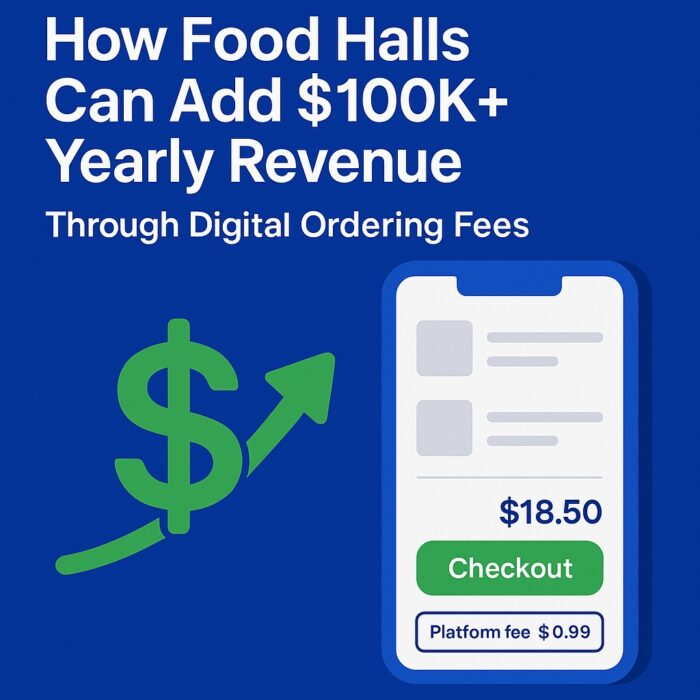
Tabski introduces a $0.99 “convenience fee” to every digital order placed by guests on their phones.
This small fee compensates for not having to wait in line — and guests are happy to pay it.
Of that $0.99 fee:
- $0.30 goes back to the food hall owner, creating a new daily revenue stream
With the average food hall seeing 8,500–10,000 digital orders per month, that translates in many cases to over $100,000 in revenue per year — simply from guests choosing convenience.
Example: A Large Multi-Vendor Food Hall
Food halls nationwide are switching to Tabski. For a hall with about a dozen restaurants and bars, Tabski’s digital ordering model projects:
- $1.25M+ in monthly volume
- 40% digital order adoption
- $0.99 per digital tab
- $100K+ annual profit shared back with ownership
This isn’t theoretical — it’s built directly into the payments flow, automatically split from the daily batch and funded to the food hall’s account.
Beyond Revenue: The Ripple Effect
Aside from pure profit, food halls also benefit from:
- Higher ticket averages: Guests order from more vendors when they don’t need to re-queue
- Reduced labor dependency: Fewer cashiers and runners are needed
- Increased throughput: Faster checkouts = more orders per hour
- Better customer satisfaction: Digital ordering shortens wait times and modernizes the experience
Automating the Rest: Rent Collection & Reporting
Since Tabski manages each vendor’s merchant ID, it can automatically route rent (e.g., 15%) to the landlord daily.
No spreadsheets. No chasing checks. Operators get accurate financials and transparency across all tenants.
The Bottom Line
Most POS systems weren’t built for food halls — they were built for single-location restaurants. Tabski is purpose-built for multi-vendor environments and turns what used to be operational headaches into profit centers.
Digital ordering fees represent the simplest, fastest path for food halls to add six-figures in annual profit without raising prices or cutting staff.
Interested in Seeing How It Works?
Request a short demo at tabski.com to see how digital ordering can transform your operations — and your bottom line.