
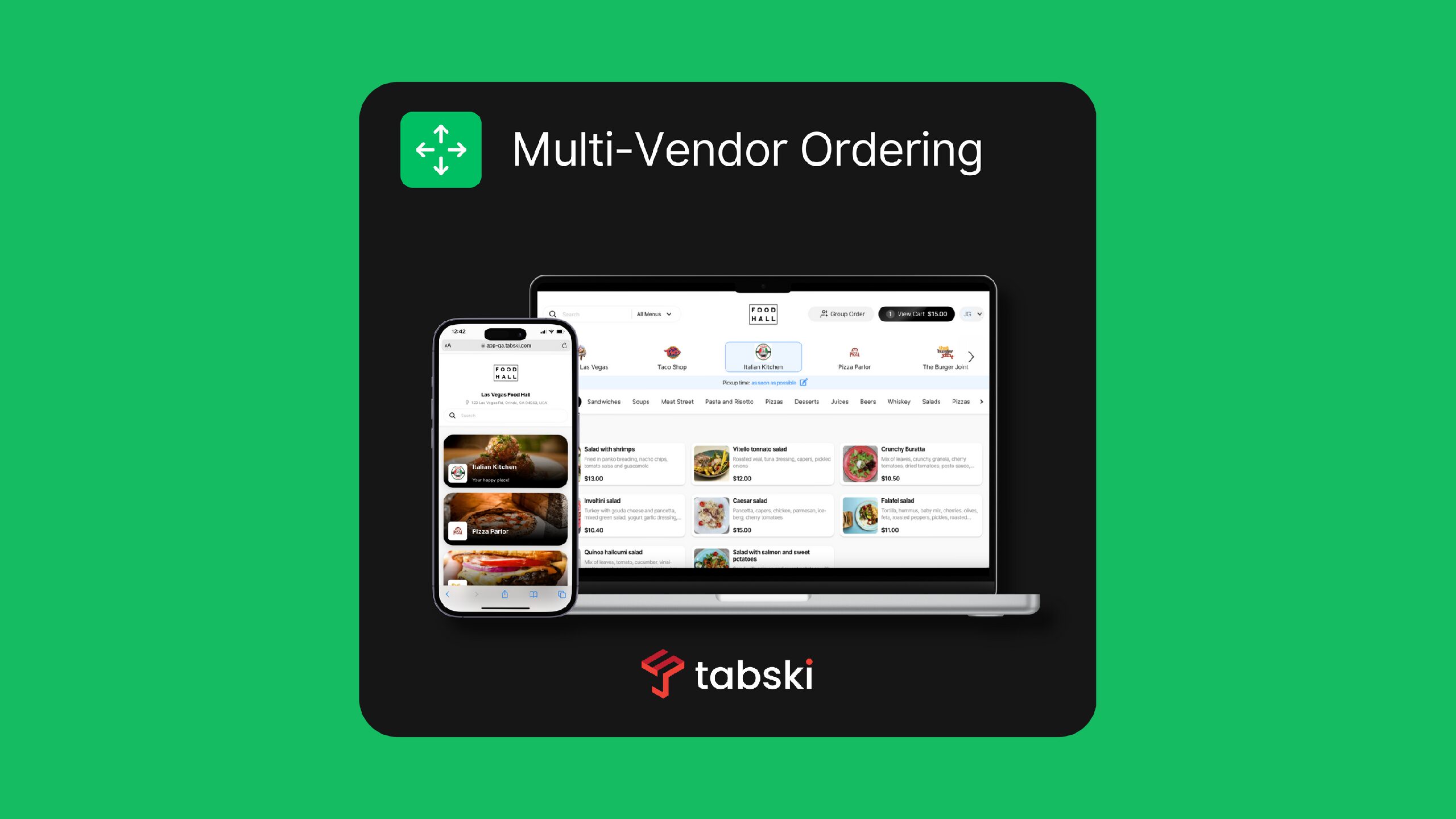
Food halls are built on a simple but powerful idea: bring multiple culinary concepts under one roof and give guests the freedom to explore them all. But behind that vibrant, bustling experience lies a complex operational challenge—managing orders, payments, and reporting for multiple independent vendors in real time.
At the center of solving this challenge is multi-vendor ordering, a technology capability that allows guests to browse, order, and pay across multiple vendors in a single transaction. For food hall operators, it’s not just a nice feature; it’s the backbone of any modern, purpose-built POS system.
This article breaks down what multi-vendor ordering is, how it works, and why it’s essential for food hall operators and vendors alike.
Defining Multi-Vendor Ordering
In a traditional restaurant, a POS system only needs to handle orders for one kitchen, one menu, and one merchant account. In a food hall, that model breaks down immediately. Guests don’t want to make separate trips or payments at each vendor stall. They want to scan a QR code, build a cart from multiple vendors, and check out once.
Multi-vendor ordering is the ability to place and pay for a single order that contains items from multiple vendors, with each item automatically routed to the correct station for fulfillment.
This requires the POS to:
- Display multiple vendor menus within one unified interface (mobile or counter).
- Allow guests to mix items from different vendors in the same cart.
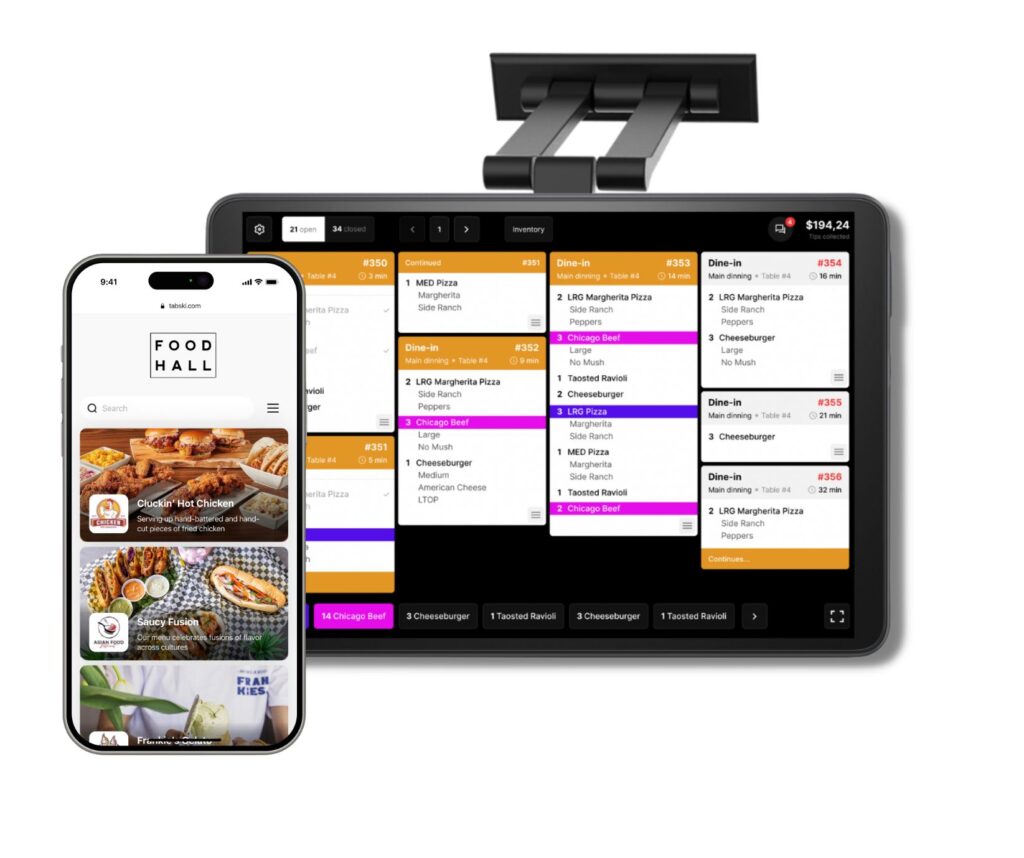
- Automatically split and route tickets to the right vendor kitchen displays or printers.
- Attribute sales accurately to each vendor for reporting and payouts.
- Settle payments in a way that splits funds appropriately between vendors and the operator.
Without this functionality, food halls are forced into clunky workarounds—like requiring guests to order and pay at each stall separately—which creates longer lines, slower throughput, and lower average tickets.
How Multi-Vendor Ordering Works Behind the Scenes
While it feels seamless to the guest, multi-vendor ordering involves several coordinated steps between the POS, ordering interface, and payment processor.
- Menu Aggregation
Each vendor manages their own menu through the POS. The system aggregates these menus into a single unified front end (mobile web or counter terminal), allowing guests to browse all options together. - Cart Building
The guest adds items from multiple vendors into one cart. The POS keeps track of which items belong to which vendor in the background. - Single Payment Authorization
When the guest checks out, the POS runs one authorization for the total amount. The transaction is processed under a single merchant structure (usually the operator’s), but the system records line-item attribution for each vendor. - Ticket Routing
The POS instantly splits the order and sends each vendor’s items to their respective kitchen display or printer. This happens automatically and simultaneously. - Fund Splitting
When the transaction settles, the payment processor or POS platform splits the funds. Vendor proceeds are sent to each vendor’s merchant account, while rent or platform fees are automatically withheld for the operator. - Reporting
Both the operator and vendors see their sales reflected accurately in real time, without having to reconcile shared orders manually.
This model not only improves the guest experience but also eliminates manual reconciliation work that can consume hours each week.
Why Multi-Vendor Ordering Is Essential for Food Halls
1. Better Guest Experience
Multi-vendor ordering removes friction for guests. Instead of standing in multiple lines or completing multiple digital transactions, they order once, pay once, and enjoy the full range of offerings. This leads to higher satisfaction, more impulse purchases, and increased repeat visits.
2. Higher Average Tickets
When guests can mix and match items from multiple vendors, average order values increase naturally. A guest might add a taco from one vendor, a smoothie from another, and a dessert from a third—all in one transaction. This benefits every vendor in the hall.
3. Faster Throughput
With mobile ordering, guests don’t crowd individual stalls just to place orders. This spreads demand more evenly across the hall and allows vendors to focus on fulfillment rather than order entry.
4. Operational Efficiency
Manual reconciliation between vendors, operators, and bars is one of the biggest headaches for food hall managers. Multi-vendor ordering, combined with automated rent collection, removes that burden almost entirely.
5. Financial Accuracy
By splitting and attributing payments automatically, multi-vendor ordering ensures clean reporting and accurate payouts. Vendors trust the numbers because the system tracks every dollar back to the originating item.
Common Problems When Multi-Vendor Ordering Is Missing
Food halls that rely on traditional POS systems without multi-vendor functionality often encounter the same issues:
- Guest frustration due to multiple checkouts and fragmented experiences.
- Inefficient labor utilization, with vendors dedicating staff to order entry rather than production.
- Manual rent collection based on spreadsheets, often leading to disputes.
- Delayed payouts to vendors because funds are collected centrally and distributed manually.
- Inaccurate reporting, especially when shared orders are split across systems.
These issues scale quickly as the number of vendors grows. A hall with three vendors might manage with workarounds, but a hall with eight vendors and two bars will find them unsustainable.
Why Most Restaurant POS Systems Can’t Handle It
Legacy restaurant POS systems are built on a single-merchant architecture. They typically don’t support routing line items to multiple vendors or splitting payments at settlement. Operators can attempt to set up multiple terminals and merchant accounts, but this creates a fragmented guest experience and complex back-office operations.
Some systems offer partial solutions, like shared ordering interfaces or batch payouts, but they rarely offer true multi-vendor ordering with real-time split funding and vendor reporting. Purpose-built food hall POS platforms are designed to solve these challenges natively.
Multi-Vendor Ordering and Payments
Multi-vendor ordering is deeply intertwined with how payments flow through a food hall. When a single guest order involves multiple vendors, the POS and processor must know exactly how to distribute funds.
The most efficient way to do this is split funding at the transaction level. Rather than collecting all funds into a central account and issuing payouts later, the payment processor allocates funds during settlement. Vendors receive their revenue directly, and the operator automatically retains rent and platform fees.
This approach reduces administrative overhead, speeds up payouts, and builds transparency between operators and vendors.
How Tabski Handles Multi-Vendor Ordering
Tabski was built specifically for food halls, so multi-vendor ordering isn’t an add-on—it’s the core of the platform.
- Single QR experience that aggregates all vendor menus.
- Automatic routing to vendor stations with no manual intervention.
- Real-time split funding to vendors and operators at settlement.
- Detailed reporting for both operators and vendors, accessible anytime.
- Integrated tab syncing for bars and shared ordering experiences.
This design allows operators to deliver a frictionless guest experience, automate financial flows, and give vendors the transparency they need to thrive.
Conclusion
Multi-vendor ordering is not a luxury for food halls; it’s a foundational capability. It impacts guest experience, vendor relationships, operational efficiency, and financial accuracy. Without it, food halls are forced to choose between clunky workarounds and expensive manual processes.
With the right POS platform, multi-vendor ordering becomes seamless. Guests enjoy the variety and speed they expect, vendors get accurate reporting and fast payouts, and operators gain the tools they need to scale efficiently.
If you’re evaluating POS systems for your food hall, start by asking a simple question: Does it support true multi-vendor ordering with split funding? If the answer is no, you’re already behind.