
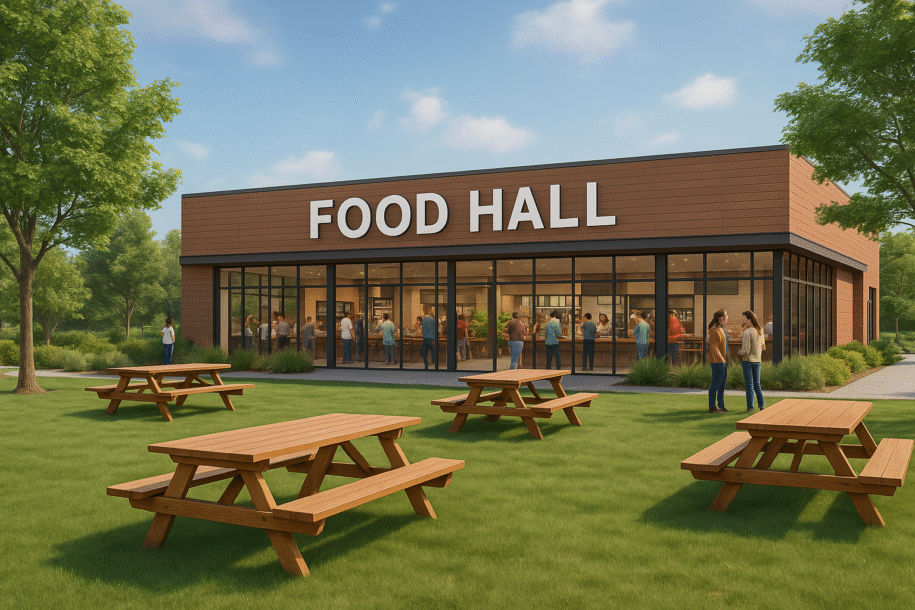
Running a food hall is a balancing act. With multiple vendors, diverse menus, and hundreds of guests walking through the doors each day, operators are responsible for keeping everything running smoothly while ensuring every vendor feels supported and every customer leaves satisfied.
But there’s one piece of the puzzle that often causes unnecessary headaches: cash. Below, we breakdown Why Food Halls Should Ditch Cash Sales.
While some operators hold on to cash acceptance because it “feels safer” or “keeps options open,” the reality is that going fully digital isn’t just a trend—it’s a way to save hours of administrative work, eliminate the hassle of bank deposits, and create a foundation for fully automated rent collection.
The Hidden Cost of Handling Cash
At first glance, cash seems straightforward. A customer pays, the vendor pockets the bills, and the food hall sees its share of rent later. But every operator knows the complications go deeper:
- Bank runs: Someone has to physically drive to the bank, deposit the cash, and reconcile it later. Multiply this by several vendors, and it quickly adds up.
- Human error: Counting bills and coins leaves plenty of room for mistakes—especially when vendors are rushing during peak hours.
- Trust & disputes: When rent is based on gross sales, how do operators know every cash transaction is being reported honestly? Even with good intentions, misreporting is common.
- Security risks: Holding large amounts of cash on-site increases theft risk—for vendors and operators alike.
These issues are so common that many operators spend several hours a week just managing the fallout from cash acceptance. By contrast, a cashless system eliminates those hours entirely.
Automating Rent Collection: No More Chasing Vendors
For food halls, rent isn’t a flat monthly lease—it’s usually a fixed percentage of gross sales. This model makes sense because it aligns the operator’s revenue with the vendor’s success. But when cash is part of the mix, collecting that rent becomes complicated.
- Operators have to trust vendors to report cash sales accurately.
- Rent often gets collected after the fact, meaning delays and potential shortfalls.
- Manual reconciliation takes time and creates friction in landlord–tenant relationships.
A cashless environment solves this instantly. With every sale flowing through the digital POS, the system automatically tracks vendor performance and calculates the correct rent owed—down to the penny.
Even better, the rent doesn’t need to be collected manually. The platform can deduct the operator’s share automatically during nightly batch settlements. That means:
- No end-of-week “rent checks.”
- No disputes about what’s owed.
- No delays or excuses.
Split Funding at the Batch Level: Instant, Accurate, Automated
The real magic of digital-only payments is split funding. This process ensures that money gets divided at the source—before it even hits the bank.
Here’s how it works in practice:
- A vendor makes $2,000 in digital net sales during the day.
- Their rent agreement is set at 15%.
- At batch close, the processor automatically splits the funds: $300 goes directly to the operator, while $1,700 goes to the vendor.
Everything happens behind the scenes. The vendor never has to cut a check, and the operator never has to chase payments. This level of automation brings unmatched accuracy and efficiency to food hall management.
Why Cashless Improves the Guest Experience Too
Going cashless isn’t only about back-office benefits. Guests feel the difference as well.
- Speed & convenience: Lines move faster when every payment is card, tap, or mobile. No waiting for change or fumbling with bills.
- Mobile-first ordering: With digital payments, guests can place orders from their phones, open tabs, and close them seamlessly without pulling out their wallets.
- Revenue Transparency: Reduces the risk of an audit and guarantees revenue transparency across vendors
- Consistency across vendors: Instead of jumping between cash, card, or app payments, guests experience one unified flow across the entire hall.
In today’s market, where customers expect speed and flexibility, cashless isn’t just a nice-to-have—it’s essential for staying competitive.
Removing Operator Headaches Once and For All
When you step back, the case for going cashless in food halls becomes clear:
- No bank trips → Hours saved each week.
- No manual reconciliations → Cleaner books and fewer errors.
- No chasing vendors → Rent collected automatically, daily.
- No trust disputes → Every sale is tracked and transparent.
- No bottlenecks at checkout → Faster lines and happier guests.
Instead of being bogged down by old-fashioned cash processes, operators can focus on growth, marketing, and improving the guest experience.
A Future-Proof Strategy for Operators
The restaurant and hospitality industry is already moving toward digital-first experiences. Food halls that embrace a cashless model position themselves as modern, efficient, and customer-friendly.
With full automation of rent collection, real-time sales tracking, and batch-level split funding, food hall operators can finally eliminate one of their biggest sources of friction. Vendors benefit from transparency, operators benefit from predictability, and customers benefit from convenience.
In other words: everybody wins.