
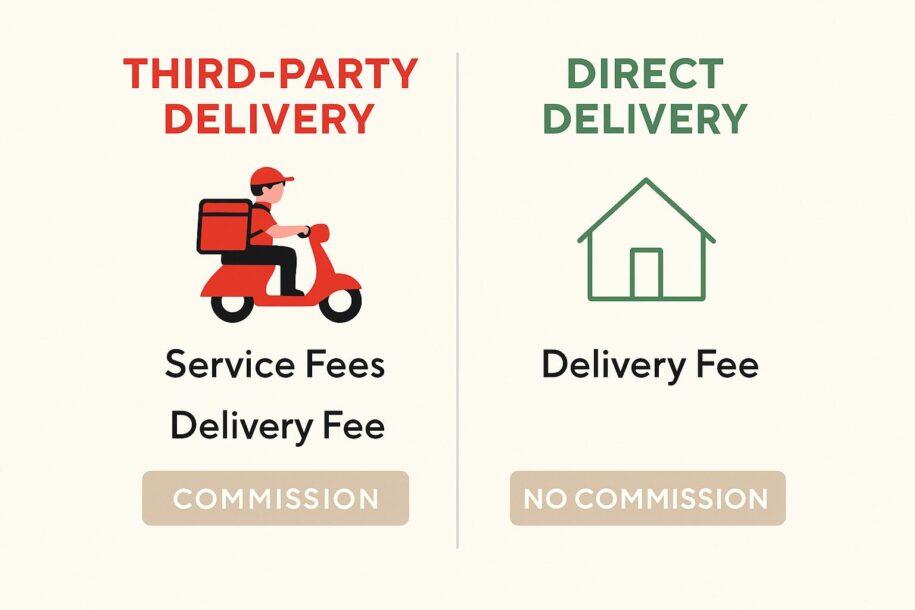
As a tenant in a food hall, you already face unique cost pressures: food costs, labor, utilities, and rent based on your sales. If you still use third party delivery platforms like DoorDash or Uber Eats to serve your customers, you may be giving away your profit — and your control.
Here’s what you need to know and what you can do about it.
The Economics of a Food Hall Tenant
In a typical restaurant, rent might be six to ten percent of gross sales. In a food hall, operators often charge rent as a percentage of sales, usually twelve to eighteen percent or more. That means for every dollar you earn, a large portion immediately goes toward rent.
With food, labor, and packaging costs already rising, there isn’t much margin left to absorb marketplace commissions. Many food hall tenants are learning that these fees push them from profit to loss.
The Marketplace Trap
Third party marketplaces promise new customers and more visibility, but they come at a high cost:
- Commissions usually range from twenty to thirty percent per order
- You still pay your food hall rent percentage on top of that
- Orders often replace dine in sales rather than adding new volume
- You lose control of your brand, customer data, and experience
Once the commission is deducted, a tenant already paying rent to the hall often ends up breaking even or losing money on each delivery.
Direct Ordering Is the Better Path
Going direct through your own ordering system or through a food hall wide digital platform changes everything.
- No commission fees — you keep the entire sale minus payment processing
- Your brand, your customers — you control pricing, presentation, and guest experience
- Better profitability — no rent stacked on top of delivery commissions
- Upsells and loyalty — easier to promote sides, drinks, or repeat visits
- Customer data ownership — you can market directly to the people who already love your food
Direct ordering means higher margins, more repeat business, and less dependence on third party apps.
Example: Cheeseburger Concept in a Food Hall
Let’s look at a real world example:
- Average ticket: $16
- Food cost: 30% → $4.80
- Labor: 27% → $4.32
- Rent: 15% → $2.40
- Overhead: 5% → $0.80
That’s $12.32 in total costs before any marketplace fees. Your profit is $3.68 or about 23%.
Add a 25% marketplace commission ($4.00), and now you’re losing $0.32 per order. Even at a 15% commission, profit drops to barely $0.50.
When you go direct, you keep the full $3.68.
SEO Tips for Food Hall Tenants Who Want More Direct Orders
- Optimize your presence on your food hall website
- Include keywords like “burgers in Town and Country food hall” or “St Louis food hall dining”
- Create a simple landing page for your concept
- Use keywords such as “local burger food hall” and link your direct ordering page
- Build local citations and reviews
- Encourage reviews on Google Maps, Yelp, and social platforms
- Promote direct ordering offers
- Use Instagram and TikTok to highlight “Order Direct” and tag your food hall
- Capture customer data
- Offer loyalty signups or SMS updates through your direct ordering platform
- Emphasize fast pickup and convenience
- Market your direct system as “Skip the Line” or “Order Ahead for Pickup”
These tactics help your brand rank higher for local search terms like food hall burgers, food hall dining, and food hall vendors.
Final Thoughts
If you pay rent as a percentage of sales and also give 25% of every order to a marketplace, your margins vanish. Direct ordering lets you reclaim control, keep your profits, and grow your customer base on your own terms.
For food hall operators, offering a unified, no commission digital ordering system creates happier tenants, higher revenue, and a stronger brand for the hall.
Go direct. Keep your margin. Strengthen your brand.