
In today’s hospitality landscape, guests expect seamless experiences, operators need real-time visibility, and staff need tools that just work. But for many breweries, food halls, and restaurants, there’s still a major operational gap hiding in plain sight:
Digital mobile ordering and the POS often don’t talk to each other in real time.
This disconnect causes headaches for staff, confusion for guests, and leaves serious revenue opportunities on the table. That’s why two-way tab syncing — a core feature of Tabski’s platform — is becoming a critical infrastructure piece for modern venues.
The Problem: Disconnected Tabs Create Friction
Many venues have adopted mobile ordering platforms to meet guest expectations. QR codes at the table, digital menus, and pay-at-the-table flows are now common. But in most POS systems, mobile orders live in a separate system, and POS tabs don’t automatically reflect what’s happening digitally.
The result?
- Multiple open tabs per guest — one on the POS, one in the digital ordering system.
- Double charges & reconciliation errors — staff can’t see what guests already ordered online, leading to duplicate orders and messy end-of-day reporting.
- Guest confusion — a customer starts a tab at the bar, orders food on their phone, and then has to close two separate checks at the end of the night.
- No single source of truth — managers and owners lose visibility into real-time sales and tab status.
For high-volume venues like food halls, breweries, and dog park bars, this isn’t a minor inconvenience — it’s a scaling blocker.
The Solution: True Two-Way Tab Syncing
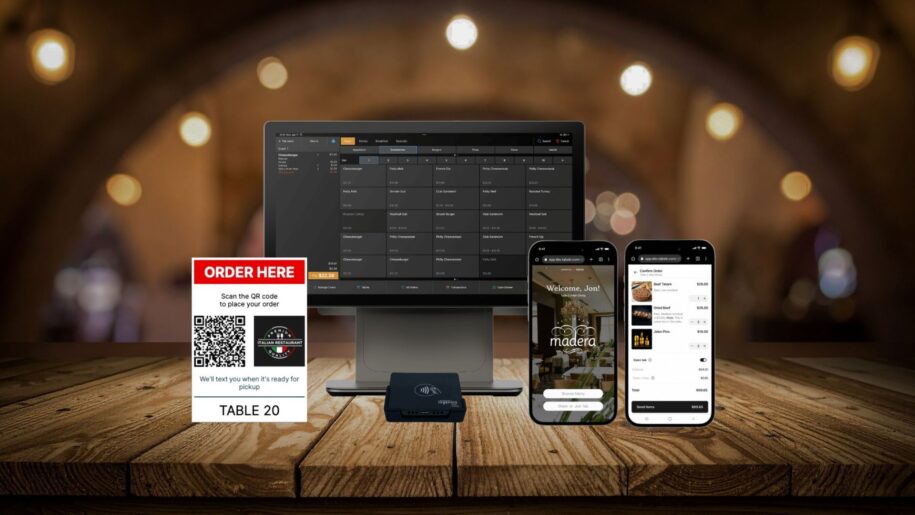
Two-way tab syncing means every action taken on the POS instantly reflects on the digital ordering side — and vice versa. Whether a guest opens a tab at the bar, adds items via QR code, or staff rings something in at a terminal, it’s all tied to a single, unified tab.
Here’s how it works with Tabski:
- Guest opens a tab at the bar — Staff creates the tab in Tabski POS.
- Guest scans a QR code at the table — Tabski recognizes the tab, allowing them to add food or drinks directly from their phone.
- Orders flow both ways — Anything added on mobile instantly appears on the POS tab, and any POS orders sync back to the guest’s digital view.
- One tab, one payment — At the end of the visit, the guest pays once, staff closes once, and reporting is clean.
No duplicates. No confusion. No manual merging. Just one living tab.
Why This Matters for Breweries, Food Halls & Beyond
1. Higher Guest Spend
When guests can keep a tab open across the bar and digital ordering, they’re far more likely to keep adding rounds or snacks throughout their visit. The friction of “starting a new check” disappears — and average ticket size goes up.
2. Fewer Staffing Bottlenecks
Bartenders can focus on pouring and hospitality, not running back and forth to merge tabs or fix billing issues. Runners and food hall vendors can see orders in real time, reducing delays and mistakes.
3. Real-Time Visibility for Operators
With two-way syncing, owners and managers get a true, real-time picture of sales across mobile and POS. No more reconciling multiple reports at the end of the night.
4. Cleaner End-of-Day Closes
One unified tab means one clean close. This dramatically reduces reporting errors and speeds up close-outs — especially important in multi-vendor environments where rent splits or batch funding happen daily.
5. Better Guest Experience
From the guest’s perspective, the experience feels effortless. They can start at the bar, move to a table, order more on their phone, and close out with a single payment. That’s the kind of seamless experience that builds loyalty.
Real-World Impact
Imagine a busy Saturday night at a brewery. A group of six opens a tab at the bar for drinks. They later sit down at a table and scan the QR to order a round of appetizers and a few more beers. With two-way tab syncing:
- The bartender sees the mobile orders appear on the original tab — no manual merge.
- The kitchen sees the order in real time.
- The group keeps ordering without waiting in line.
- At the end of the night, they close out a single tab.
The venue sees higher spend per guest, lower labor drag, and zero tab confusion.
In a food hall, the benefits are even bigger: guests can order from multiple vendors, bars, or kiosks — and every order syncs to one tab. That makes automated rent collection at batch level seamless, because there’s a single financial trail per guest.
The Future Standard
As digital ordering becomes a core part of hospitality, two-way tab syncing will move from “nice to have” to “non-negotiable.” Venues that continue to run separate systems will find themselves bogged down by operational inefficiencies and guest friction.
Tabski was built for this future. Our platform offers native two-way syncing between mobile and POS — no clunky third-party middleware, no hacks, no nightly exports.
If you’re a brewery, food hall, or hospitality operator looking to unify your guest experience and tighten operations, book a strategy session to see two-way tab syncing in action.